
Painting over pieces that have a lacquer finish or any high-gloss top-coat finish is completely doable. After following these steps, tackling such pieces becomes a manageable task.
Determining The Material of Your Cabinets
It is pretty hard to paint over varnish cabinets to remodel your kitchen unless you fully strip off the varnish and sand down the cabinets. Quite frankly, it is a lot of work, but there is a primer made for varnish cabinets so you can go straight to painting.
There are some types of cabinets you really shouldn’t paint over, such as open-grain wood.
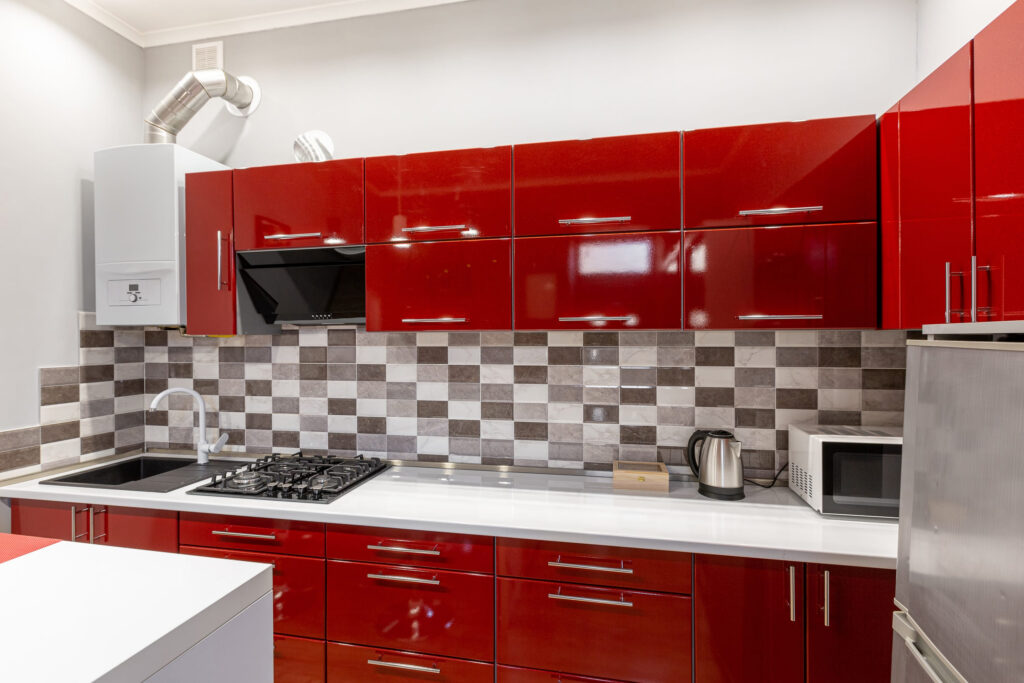
How To Paint Gloss Kitchen Cabinets?
They typically have a lot of holes and dents on the surface. If you paint over cabinets with dents, those dents will look even more noticeable.
Removing The Cabinet Doors and Drawers
Remove the hardware and put it in a ziplock bag so that you don’t misplace them. Start by taking off the cabinet doors and drawers. While painting the drawers, use an Allen key to pull the drawers out, then start painting.
Prepping The Cabinets for Painting
When doing a large number of cabinet doors, there is going to be a lot of atomized dust. Taking a superfine little sponge for dust removal is a last-ditch effort to get the dust off. Using a compressor is a little tool of the trade for getting in all these little nooks and crannies.
If you have nicks, bumps, or divots in the surfaces, fill some of the dents with wood filler. Use a putty knife to spread wood filler over the damage and then allow it to dry. For cabinet doors, clean the whole surface with a heavy-duty cleaner before you prime, like TSP, to increase kitchen cabinet lifespan.
Priming The Cabinets
Priming is the most important step that you don’t want to miss when painting over a lacquer finish or any high-gloss top coat finish. A bonding primer acts as a layer between the paint and the slick surface. Cover the slick surface with the bonding primer. For varnish cabinets, use a specialty primer, but if painting unvarnished cabinets with standard paint, the steps are the same.
Suggest one to two coats of the bonding primer to conceal the lacquer finish. Use a mini roller on large flat areas. Primer doesn’t have to look perfect; its purpose is to cover the surface and provide a good base for the finish paint. Work on one area at a time. On the cabinet frames, work from inside out. If painting on the inside of the cabinets, start at the back and work towards the front. Use a brush to get into corners and detailed areas using even strokes.
Picking Out Paint Color and Finish
A matte finish gives a flatter, low-gloss finish. A high gloss finish provides a high sheen, and a satin finish falls between the two. Semi-gloss and satin finishes are typically used in kitchens. A gloss finish will give cabinets a lot of sheen, but it may show a lot of dings and mistakes, and some flat finish paints can be difficult to clean.
Painting Technique
Take a brush and spray it with some clear water to dampen it, then start painting. The whole purpose of dampening your brush is to put on a very thin layer of paint onto your furniture. If you put thick coats of paint, it is going to peel. A unique hack is the sock hack: wear a glove and a sock, spray some clear water on it, take a tiny bit of paint, and start painting. The sock does not hold enough paint, laying very thin coats of paint onto the surface.
When using a sprayer for small pieces, an HVLP or cup gun works for the thinner stuff, or shoots pigmented lacquer for a smooth finish. Lay everything down on drying racks, shooting all the backs first because the final shot is on the faces.
Use even strokes with the brush or roller. Finish the stroke back into the wet paint and feather out the edges. Do not rush; let the paint completely cure and follow directions for the correct dry time. In between coats, lay off using a dry roller or brush to lightly go over the surface to remove any buildup. Apply a second coat of paint after the first one dries.
Sealing and Finishing
Sealing uses a clear top coat. A thin clear coat gives enough time to play around and get a flawless finish. Wait before putting on that second coat of top coat. Wait six to eight hours, then apply two coats of top coat.
Once your cabinet paint is completely dry, attach your hardware and reinstall your doors.